
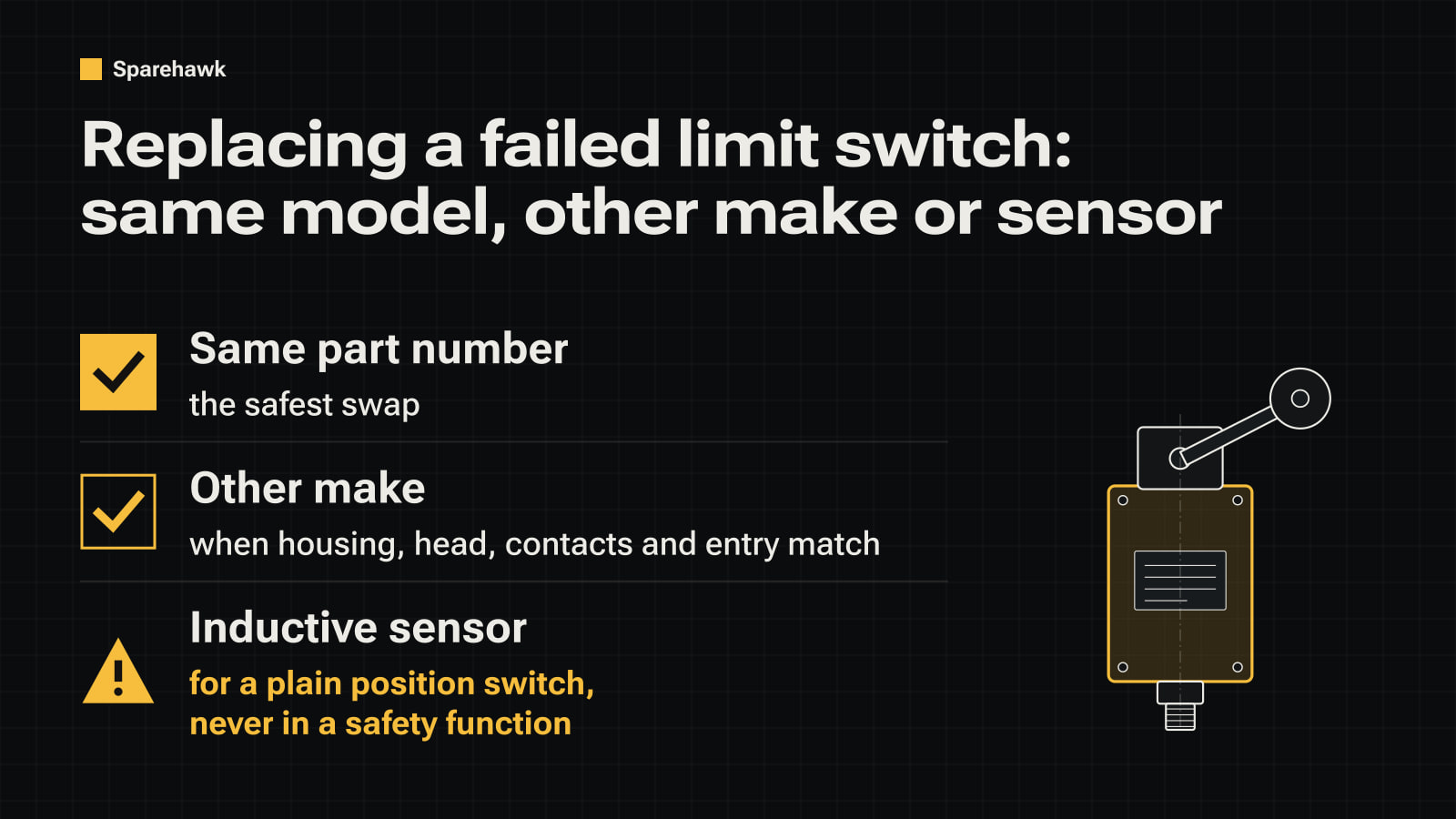
A limit switch is a cheap part, but a failed one stops a conveyor, a lift or a guarded door as surely as a failed drive. Most wrong replacements go wrong on the actuator head or the contacts, not on the brand.
What to read off the old switch
Photograph the label and the head before you remove anything. Then note these details:
- Brand and full part number, including the suffixes for the head and the contacts.
- Housing: a 40 mm wide body to EN 50041 or a 30 mm wide body to EN 50047. Both standards fix the mounting holes and the actuator position.
- Actuator: roller lever, adjustable rod, plunger or roller plunger, and the side it is mounted on.
- Contacts: for example 1NO+1NC, snap action or slow action, and whether the NC contact carries the positive opening symbol, an arrow in a circle.
- Rating: the utilisation category, AC-15 or DC-13, with its voltage and current.
- Connection: a cable gland M20x1.5 or an M12 connector, plus the IP rating. See IP ratings on a replacement part.
Same model, another make or a sensor
| Option | What must match | What to watch |
|---|---|---|
| Same part number | Nothing beyond the number | A superseded number may come with a different head code |
| Another make, same standard housing | Housing standard, actuator, contacts, rating and connection | Switching point and overtravel differ between makes |
| Inductive proximity sensor | Supply voltage, PNP or NPN output, sensing distance and a metal target | No positive opening, so it cannot take over a safety function |
Many makes build switches to these two standards, for example the Siemens 3SE5 family. Check which standard the data sheet names before you cross over to another brand.
A sensor needs a different cable and often a different input setting in the PLC. It suits position feedback. It does not suit a stop that must open even when a contact has welded.
When the switch is part of a safety function
A switch that monitors a guard door, an overtravel end stop or a hoist limit is a safety component. Read what that term means for a spare part. Replace it with the same part, or with a switch whose safety data and positive opening contacts match what the risk assessment assumed. Guard interlocks also fall under EN ISO 14119, which covers mounting and protection against defeat.
Never swap a positive opening contact for a plain one. Never replace a safety switch with an inductive sensor that is not rated for that function.
Fitting a switch from another make
Turn the head to face the same direction as the old one. Most heads rotate in steps of 90 degrees. Set the lever so the switch trips at the same cam position and still has overtravel left. Test the stop at slow speed before the machine runs normally again.
Searching and requesting quotes
Search Sparehawk with the ordering code as printed, with or without spaces. Where a number has been superseded, the current part and its predecessors are both shown. One request for quotes can cover the switch, a spare actuator head and a second switch for the opposite end stop. If nobody lists the part, post a wanted request and suppliers can answer it.